Die-Cut Adhesive Tape: Materials, Tolerances and Industrial Applications
What Is Die-Cut Adhesive Tape?
Die-cut adhesive tape refers to pressure-sensitive adhesive (PSA) tapes that have been precision-converted from standard master rolls into custom, pre-determined shapes and dimensions. Rather than requiring manual cutting, measuring, or dispensing during assembly, die-cut components are engineered to match exact part geometries, holes, slots, and contours.
Using specialized converting machinery-such as flatbed presses, rotary stations, or laser systems-manufacturers stamp, kiss-cut, or through-cut single-sided, double-sided, or transfer adhesive tapes. Depending on assembly line requirements, the finished parts are delivered on release liners in roll form (for automated pick-and-place dispensing), sheet form (for batch manual assembly), or as individual pieces with extended pull-tabs for easy liner removal. In modern industrial manufacturing, die-cut adhesive tapes replace mechanical fasteners, liquid glues, and welds to streamline assembly, reduce weight, and ensure consistent bonding quality.
Common Materials Used in Die-Cut Adhesive Tape
Selecting the right carrier (backing) material determines the mechanical strength, conformability, and environmental resistance of the die-cut part.
PET Film
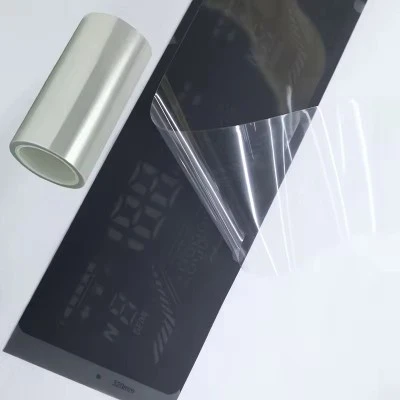
Polyethylene Terephthalate (PET) film is one of the most widely used carriers in precision converting due to its high tensile strength, dimensional stability, and moisture resistance. PET resists stretching during high-speed rotary die-cutting, allowing for tight tolerances on thin, intricate geometries. It is commonly used for LCD screen mounting, membrane switch spacers, and electrical insulation barriers.
Foam Materials
Foam carriers-typically acrylic, polyethylene (PE), or polyurethane (PU)-provide thickness, compressibility, and viscoelastic shock absorption. Closed-cell foams seal against dust and moisture while compensating for surface irregularities and thermal expansion mismatches between dissimilar substrates. Applications include automotive trim attachment, structural glazing, vibration damping, and acoustic gasketing.
Non-Woven Materials
Non-woven tissue carriers consist of randomly oriented synthetic or cellulose fibers saturated with adhesive. This porous structure makes the tape lightweight, flexible, and easy to tear or conform around curved profiles while maintaining reliable dimensional stability during die-cutting. Non-woven double-sided tapes are widely applied in nameplate mounting, foam/felt lamination, and general-purpose bonding.
Polyimide and Insulation Materials
Polyimide (PI) films, alongside specialty electrical papers (such as Nomex®) and flame-retardant polycarbonate (PC) or polypropylene (PP) films, are engineered for extreme thermal and dielectric environments. Polyimide maintains mechanical integrity and electrical insulation at continuous temperatures up to 260°C (500°F) without shrinking or melting. These materials are essential for wave-soldering masking, battery cell insulation, transformer wrapping, and flexible printed circuit (FPC) reinforcement.
Adhesive Types and Material Selection
The adhesive chemistry governs initial tack, ultimate peel strength, shear resistance, and environmental durability. Selection depends directly on the substrate's surface energy and service conditions.
|
Adhesive Chemistry |
Typical Continuous Temp. Range |
Surface Energy Compatibility |
Key Characteristics & Trade-offs |
|
Acrylic |
-40°C to 150°C (-40°F to 302°F) (up to 200°C short-term) |
High to Medium Surface Energy (HSE/MSE) - metals, glass, ABS, PC |
High UV, chemical, and aging resistance; shear strength builds over 24–72 hours; modified acrylics bond to LSE plastics. |
|
Silicone |
-60°C to 260°C (-76°F to 500°F) |
Ultra-Low Surface Energy (LSE) - silicone rubber, PTFE, powder-coated surfaces |
Exceptional thermal stability and chemical inertness; lower initial peel strength compared to acrylic or rubber. |
|
Rubber-Based |
-20°C to 70°C (-4°F to 158°F) |
Low Surface Energy (LSE) - PE, PP, EPDM, rough/textured surfaces |
Very high initial tack ("quick stick") and immediate bond; limited UV, solvent, and high-temperature resistance. |
Acrylic Adhesive
Acrylic adhesives offer an optimal balance of long-term environmental durability, UV stability, and resistance to plasticizers and solvents. Pure acrylics bond strongly to high-surface-energy (HSE) substrates like stainless steel, aluminum, and glass, while modified acrylic formulations are engineered to wet out low-surface-energy (LSE) plastics such as polypropylene (PP) and powder-coated metals. They are the standard choice for permanent outdoor, automotive, and electronics bonding.
Silicone Adhesive
Silicone pressure-sensitive adhesives are formulated for extreme thermal cycles and chemically aggressive environments where organic adhesives degrade. They are uniquely capable of bonding to silicone rubber gaskets and fluoropolymers (such as PTFE). While their room-temperature peel adhesion is generally lower than acrylics, silicone adhesives maintain stable performance from cryogenic temperatures up to 260°C and remove cleanly without residue in high-temperature masking operations.
Rubber-Based Adhesive
Synthetic and natural rubber-based adhesives deliver aggressive initial tack and high immediate peel strength upon light contact, requiring minimal dwell time. They conform well to rough, irregular, or low-surface-energy surfaces like polyethylene (PE) and untreated foams. Because rubber polymers oxidize under prolonged UV exposure and soften at elevated temperatures, they are best suited for indoor applications, temporary holding, and cost-sensitive foam lamination.
Die-Cutting Processes and Precision Requirements
The choice of converting method impacts dimensional accuracy, edge quality, tooling cost, and production scalability.
Flatbed Die Cutting
Flatbed die cutting uses a steel-rule die or matched metal die pressed vertically against the tape web.
Best For: Thick materials (foams, heavy rubber, multi-layer laminates over 0.5 mm), large part dimensions, and low-to-medium production volumes.
Characteristics: Low initial tooling cost and short setup time. Because the cutting action is vertical, thick foams experience minimal lateral distortion. Typical dimensional tolerances range from ±0.15 mm to ±0.25 mm, depending on material compressibility.
Rotary Die Cutting
Rotary die cutting feeds the tape web continuously between a cylindrical engraved or flexible magnetic die and a hardened anvil cylinder.
Best For: High-volume production runs, thin films (PET, Polyimide), non-wovens, and multi-station converting (combining laminating, slitting, island placement, and waste matrix stripping in one pass).
Characteristics: High speed and superior repeatability. While cylindrical tooling carries a higher upfront investment than flat steel-rule dies, per-part costs drop significantly at scale. Typical tolerances reach ±0.05 mm to ±0.10 mm on dimensionally stable film carriers.
Laser Die Cutting
Laser die cutting uses a focused, CNC-controlled laser beam to vaporize and cut the material without physical tooling contact.
Best For: Rapid prototyping, ultra-complex internal geometries, micro-parts, and delicate or brittle substrates that might tear under mechanical shear.
Characteristics: Zero tooling cost and instant CAD file adjustments. Laser cutting can achieve tolerances of ±0.025 mm to ±0.05 mm. However, heat-affected zones (HAZ) may cause slight edge discoloration or melting on certain thick polymers, and throughput is slower than rotary converting for large volumes.
Industrial Applications of Custom Die-Cut Tape
Electronics and Electrical Components: Acoustic mesh attachment, display bezel bonding, battery pack insulation pads, EMI/RFI shielding gaskets, thermal interface pads, and flexible circuit stiffeners.
Automotive Assembly: Interior trim and emblem mounting, wire harness wrapping, NVH (noise, vibration, and harshness) damping pads, sensor sealing gaskets, and mirror mounting.
LED Lighting: Thermally conductive transfer tapes for bonding LED strips and PCBs to aluminum heat sinks, optical reflector mounting, and IP-rated housing seals.
Medical Devices: Skin-friendly hydrocolloid and breathable non-woven dressings, wearable sensor adhesives, microfluidic diagnostic channel layers, and surgical drape fixation.
General Industrial Manufacturing: Appliance control panel overlays, nameplate and badge mounting, solar panel junction box sealing, and HVAC foam gasketing.
Custom Die-Cut Tape: Specifications to Confirm
To ensure your die-cut components perform reliably on the assembly line and in end-use conditions, confirm the following technical parameters before requesting production:
Material and Adhesive Type: Specify the exact carrier (e.g., PET, PE foam, polyimide) and adhesive chemistry (acrylic, silicone, rubber), or provide a target OEM tape reference (e.g., 3M, Nitto®, Tesa) along with any required UL 94 flame ratings or RoHS/REACH compliance.
Thickness: Confirm total stack-up thickness-including carrier and adhesive layers-along with acceptable thickness tolerances (typically ±10% for foams and ±5% for films).
Length and Width: Define overall part dimensions, roll widths, core inner diameters (standard 3-inch / 76 mm), or sheet layouts required to fit your automated feeders or workstations.
Die-Cut Shape and Dimensions: Provide a 2D vector CAD drawing (DXF, DWG, or AI format) indicating critical dimensions, corner radii, internal cutouts, and required dimensional tolerances (e.g., ±0.10 mm).
Liner Requirements: Specify release liner material (glassine paper, PET film, or PE-coated kraft), color, thickness, kiss-cut vs. through-cut format, and whether extended finger-lift pull tabs are needed for manual application.
Application Surface and Operating Environment: Detail the mating substrates (e.g., anodized aluminum, polypropylene, glass), surface texture, minimum/maximum operating temperatures, and exposure to moisture, UV light, or chemicals.
Frequently Asked Questions
What materials are used for die-cut adhesive tape? Common carrier materials include PET film, closed-cell PE/PU/acrylic foams, non-woven tissues, polyimide (Kapton®), aluminum/copper foils, and electrical insulation papers. These are paired with acrylic, silicone, or rubber-based pressure-sensitive adhesives depending on the bonding substrate and temperature requirements.
What is the difference between rotary and flatbed die cutting? Rotary die cutting uses cylindrical dies for high-speed, continuous roll-to-roll converting, making it ideal for high-volume runs and thin films requiring tight tolerances (±0.05–0.10 mm). Flatbed die cutting uses vertical pressing with steel-rule dies, which is better suited for thick foams, larger parts, and lower production volumes with lower initial tooling costs.
Can die-cut tape be customized to specific dimensions? Yes. Die-cut tapes can be manufactured to virtually any 2D geometry, including rings, gaskets, micro-dots, multi-layered laminates, and complex irregular contours. Parts can be supplied kiss-cut on rolls for automated dispensing, on sheets for batch assembly, or as individual pieces with pull tabs.
What information is needed for a custom die-cut tape quotation? To prepare an accurate quote, suppliers typically need a 2D CAD drawing (DXF/DWG) showing dimensions and tolerances, material and thickness specifications (or application requirements for material recommendation), presentation format (roll vs. sheet, kiss-cut vs. through-cut), and estimated order quantity.
Looking for Custom Die-Cut Adhesive Tape?
Whether you are moving from early-stage prototyping to high-volume production or need help selecting the right adhesive stack-up for a demanding substrate, STK provides end-to-end custom die-cutting and material converting solutions.
Share your CAD drawings, material preferences, thickness requirements, and application environment with our engineering team to receive tailored material recommendations, samples, and a detailed quotation.
Contact STK today at stktape.com to discuss your custom die-cut adhesive tape project.